
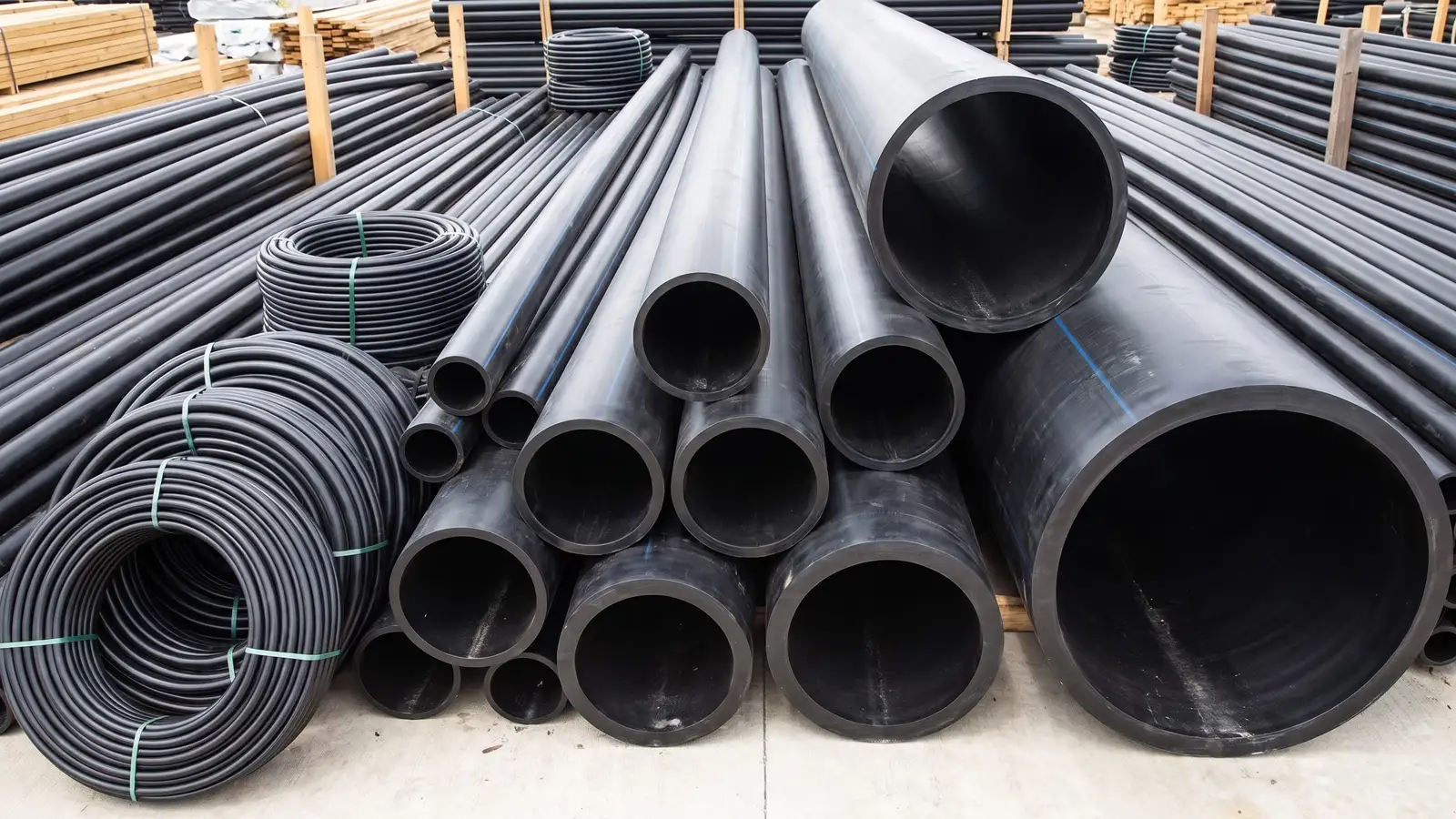
HDPE pipe is sized by its outside diameter (OD) and its SDR — not by a single nominal number the way many people expect. For a given size the OD is fixed, so a 4-inch IPS pipe always measures 4.500 inches across the outside whether its wall is thick or thin. The SDR (Standard Dimension Ratio) then sets the wall thickness, and the inside diameter is whatever is left. That one idea explains almost every HDPE pipe size chart you will see.
This guide breaks down how HDPE pipe dimensions work, gives you a full IPS outside-diameter chart in inches and millimeters, lists SDR pressure ratings, and shows how to pick the right size — so you can specify poly pipe without second-guessing the numbers.
Why HDPE Pipe Sizing Confuses People
HDPE does not follow the sizing logic of the pipe it replaces. The nominal size is not the inside diameter, and it is not always the outside diameter either. Several sizing systems — IPS, DIPS, CTS and SIDR — assign different outside diameters to the same nominal size, so a “6-inch” pipe in one system will not match a “6-inch” pipe in another. On top of that, the SDR changes the wall thickness and the inside diameter for the same OD, which changes both the pressure rating and the flow.
Get the numbers wrong and the costs are real: fittings and fusion tooling that do not match the OD, a pressure class too low for the line, a bore too small for the required flow, or a connection that will not tie into existing infrastructure. Anyone clamping something to the pipe — including pipe floats — needs the true outside diameter, not the nominal label, to get a proper fit.
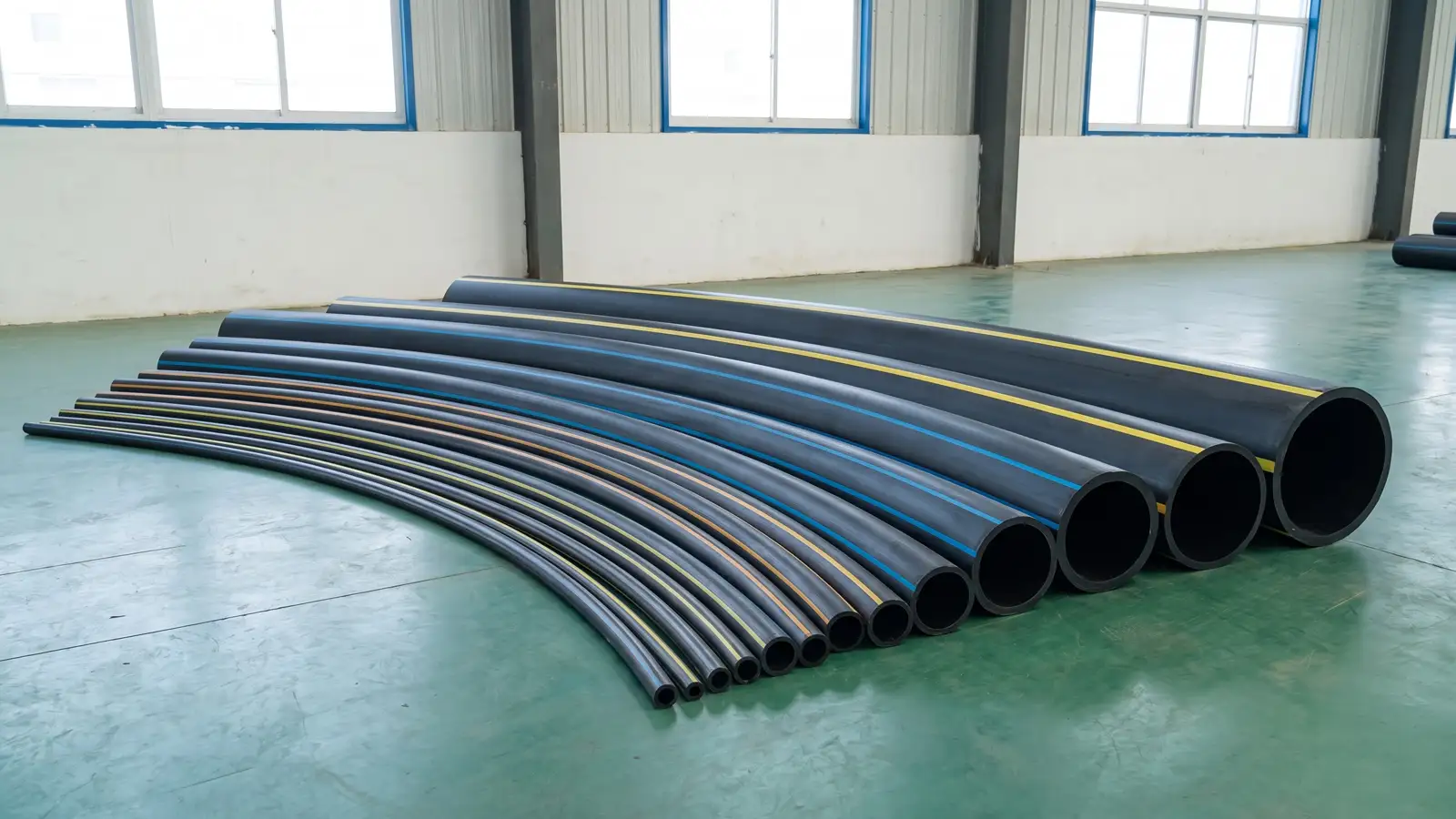
How HDPE Pipe Sizing Works
Outside Diameter Is the Fixed Dimension
Most HDPE pressure pipe is OD-controlled: the outside diameter is held constant for each size, the SDR sets the wall, and the inside diameter is the result. Because the OD never changes for a given size, the same fittings, couplings and clamps fit every SDR of that size. The main exception is SIDR pipe, which is ID-controlled and used mainly for conduit where a consistent bore matters more than the OD.
SDR and Wall Thickness
SDR is simply the outside diameter divided by the minimum wall thickness (SDR = OD ÷ wall). A lower SDR means a thicker wall relative to the diameter and a higher pressure rating; a higher SDR means a thinner wall and a lower rating. The term DR (Dimension Ratio) is used interchangeably with SDR. Because SDR is a ratio, the pressure rating is the same across every diameter of the same SDR and material — SDR 11 PE4710 is rated 200 psi whether it is 2 inch or 24 inch pipe.
Sizing Systems: IPS, DIPS, CTS and SIDR
IPS (Iron Pipe Size) matches the OD of carbon steel pipe and is the most common system for gas, oil and gas gathering, mining and industrial lines. DIPS (Ductile Iron Pipe Size) matches ductile iron and is standard for municipal water and sewer — its OD is larger than IPS at the same nominal size (a 6-inch DIPS pipe is about 6.90 inches versus 6.625 for 6-inch IPS). CTS (Copper Tube Size) is used for small water and gas service lines, and SIDR is the ID-controlled conduit system. Always confirm the system before ordering, because the OD determines fitting and fusion compatibility.
PE4710 Material
Nearly all modern HDPE pressure pipe is made from PE4710 resin, which carries a hydrostatic design stress of 1,000 psi at 73°F and has replaced older PE3408 in most applications. The pressure ratings in the SDR table below are for PE4710 at 73°F; at higher temperatures the rating derates, to roughly 50% at 140°F, the top of HDPE’s recommended range.
How to Choose the Right HDPE Pipe Size
Five inputs decide the size, SDR and sizing system for a line:
- Pressure requirement — start from the maximum operating pressure including surge, then pick an SDR that covers it with margin. Most specs want a pressure class at least 1.5x the working pressure.
- Flow and velocity — the inside diameter sets flow capacity. HDPE tolerates higher velocity than PVC, which can sometimes allow a smaller diameter for the same flow.
- Sizing system compatibility — match IPS or DIPS to whatever you are tying into so the outside diameters line up at transitions.
- Installation method — horizontal directional drilling loads the pipe during pullback, so it often calls for a thicker wall (lower SDR) than pressure alone would require.
- Fittings, fusion and tooling — butt-fusion machines, electrofusion couplings and mechanical fittings are all sized to a specific OD. Confirm they are available for your size and system, and reference the applicable ASTM (D3035, F714, D2513) or AWWA (C901, C906) standard when you order.
HDPE Pipe Size Chart: IPS Outside Diameters
This IPS outside-diameter chart covers the sizes most often floated or fused in the field, in both inches and millimeters. The SDR 11 wall is shown as an example; the minimum wall for any other SDR is simply the OD divided by that SDR.
|
Nominal Size |
Outside Diameter (in) |
Outside Diameter (mm) |
SDR 11 Min Wall (in) |
|---|---|---|---|
|
1″ |
1.315 |
33.4 |
0.120 |
|
2″ |
2.375 |
60.3 |
0.216 |
|
3″ |
3.500 |
88.9 |
0.318 |
|
4″ |
4.500 |
114.3 |
0.409 |
|
6″ |
6.625 |
168.3 |
0.602 |
|
8″ |
8.625 |
219.1 |
0.784 |
|
10″ |
10.750 |
273.1 |
0.977 |
|
12″ |
12.750 |
323.9 |
1.159 |
|
14″ |
14.000 |
355.6 |
1.273 |
|
16″ |
16.000 |
406.4 |
1.455 |
|
18″ |
18.000 |
457.2 |
1.636 |
|
20″ |
20.000 |
508.0 |
1.818 |
|
24″ |
24.000 |
609.6 |
2.182 |
|
32″ |
32.000 |
812.8 |
2.909 |
For IPS pipe, the nominal size equals the true OD at 14 inches and above. DIPS, CTS and SIDR use different outside diameters — confirm the sizing system before ordering pipe, fittings or fusion tooling.
HDPE SDR Pressure Ratings (PE4710 at 73°F)
The same OD is available in several SDRs. A lower SDR gives a thicker wall and a higher pressure rating; a higher SDR gives more bore and less pressure capacity.
|
SDR |
Pressure Rating (73°F) |
Pressure Class |
Typical Applications |
|---|---|---|---|
|
SDR 7 |
335 psi |
Class 335 |
High-pressure industrial, force mains, fire suppression |
|
SDR 9 |
250 psi |
Class 250 |
Water transmission, high-pressure distribution |
|
SDR 11 |
200 psi |
Class 200 |
Water mains, gas distribution, fire lines |
|
SDR 13.5 |
160 psi |
Class 160 |
Municipal water distribution |
|
SDR 17 |
100 psi |
Class 100 |
Low-pressure water, gravity sewer, conduit |
|
SDR 21 |
80 psi |
Class 80 |
Storm drainage, non-pressure conduit |
|
SDR 26 |
63 psi |
Class 63 |
Gravity flow, large-diameter drainage |
Matching HDPE Pipe Sizes to Applications
Each use has its own sizing conventions. HDPE water pipe for distribution usually follows DIPS in SDR 9 or SDR 11; gas distribution uses IPS and CTS per ASTM D2513; sewer and drainage run larger IPS or DIPS in SDR 17 to SDR 21 for gravity flow; and electrical or telecom conduit uses IPS in SDR 13.5 or SDR 17.
Heavier-wall pipe shows up where the service is demanding. Mining tailings, industrial slurry and high-pressure lines commonly use SDR 7 or SDR 9, often in large IPS diameters. HDPE pipe for dredging is typically IPS pipe floated on the surface, where the outside diameter — not the nominal size — is what you match your floats and clamps to.
How HDPE Pipe Sizes Relate to EZ Connect Floats
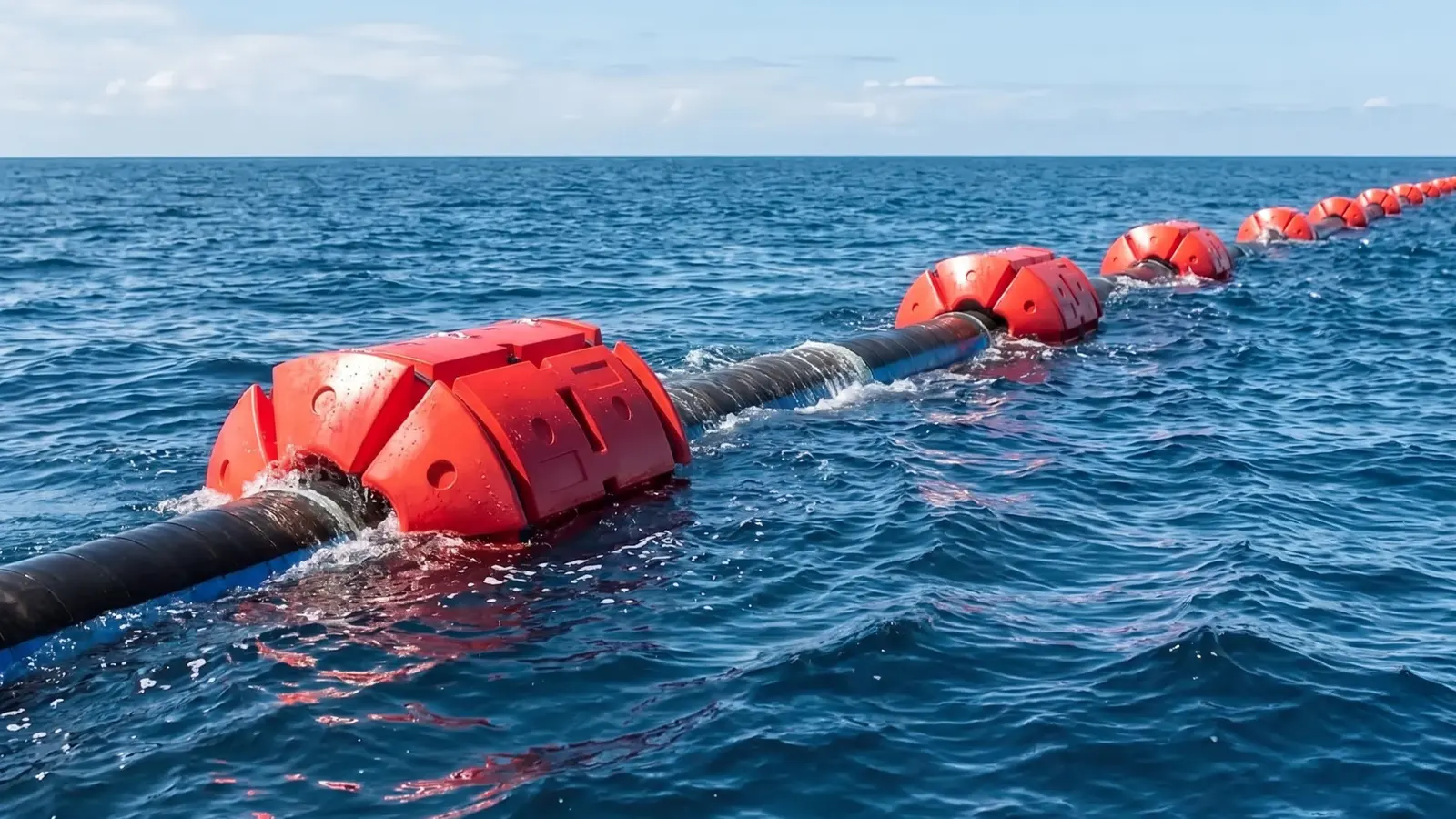
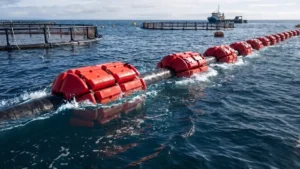
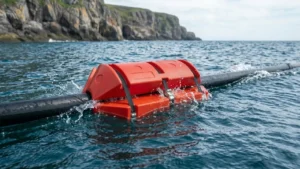
If your HDPE line has to float — for dredging, mining discharge, or a temporary marine construction pipeline — the outside diameter from the chart above is the number that matters. Pipe floats clamp to the OD, so a float sized to 8-inch IPS pipe fits the 8.625-inch outside diameter regardless of the SDR or wall thickness.
EZ Connect modular HDPE pipe floats fit lines from 1 inch to 32 inches, clamp on with a stainless steel ratchet, and add 67 lbs (30.4 kg) of buoyancy each with no foam fill. Find your pipe’s OD in the chart, and our team can size floats-per-set and total buoyancy from there — whether the line is HDPE, steel or hose.
HDPE Pipe Size FAQs
What is HDPE pipe?
HDPE pipe is high-density polyethylene pipe — a flexible, corrosion-resistant plastic pipe joined by heat (butt) fusion into leak-free, monolithic lines. It is widely used for water, gas, sewer, mining and dredging service.
What size HDPE pipe do I need?
Work back from flow and pressure. The inside diameter sets flow capacity, so size the bore for your required flow rate, then pick an SDR whose pressure rating covers your maximum operating pressure with margin. Match the sizing system (IPS or DIPS) to whatever you are connecting to.
How do I read an HDPE pipe size chart?
Find the nominal size, then read across to the outside diameter — that fixed OD is what fittings, fusion tooling and floats match. The SDR column (or a separate SDR table) tells you the wall thickness and pressure rating available for that OD.
What does SDR mean on HDPE pipe?
SDR is the Standard Dimension Ratio — the outside diameter divided by the minimum wall thickness. A lower SDR is a thicker wall and higher pressure rating; a higher SDR is thinner wall and lower pressure. The rating is the same at every diameter for a given SDR.
Are HDPE pipe sizes the same as steel or PVC?
IPS HDPE shares the same outside diameters as carbon steel pipe, which is why they use the same fittings. PVC and HDPE nominal sizes can look alike but the pressure and wall systems differ, so confirm the OD and SDR rather than assuming they match.
What are HDPE pipe sizes in mm?
The outside diameter converts directly: for example 4 inch is 114.3 mm, 8 inch is 219.1 mm, 12 inch is 323.9 mm and 32 inch is 812.8 mm. The full inch-to-mm OD chart is above.
Which HDPE pipe sizes can be floated?
Any size can be floated with correctly sized pipe floats. EZ Connect floats cover 1 inch through 32 inch outside diameters, so most IPS dredging and discharge lines are within range.
Floats for Marine Construction: Complete Buyer’s Guide
This guide explains how dredge pipe floats work, how to size and space them, how the main float types compare, and where clamp-on HDPE dredge pipe floats fit — so a floating dredge pipeline stays on the surface through the whole job.
How to Install Pipe and Hose Floats in the Field: Step-by-Step Guide
This guide explains how dredge pipe floats work, how to size and space them, how the main float types compare, and where clamp-on HDPE dredge pipe floats fit — so a floating dredge pipeline stays on the surface through the whole job.
Dredge Pipe Floats: How They Keep a Floating Dredge Pipeline on the Surface
This guide explains how dredge pipe floats work, how to size and space them, how the main float types compare, and where clamp-on HDPE dredge pipe floats fit — so a floating dredge pipeline stays on the surface through the whole job.